How do I know how high my home’s radon levels are?
Testing is the only way to know if you and your family are at risk from radon. EPA and the Surgeon
General recommend testing all homes below the third floor for radon.
You cannot predict radon levels based on state, local, and neighborhood radon measurements. Do not
rely on radon test results taken in other homes in the neighborhood to estimate the radon level in your
home. Homes which are next to each other can have different radon levels. Testing is the only way to
find out what your home's radon level is.
How does radon cause cancer?
All radioactive elements break down (radioactive decay) over time through a process measured in half-
lives. As these elements breakdown, they actually create entirely new elements, each with its own
specific half-life. Each time a new element is created, it releases more radiation. The faster this occurs,
the more the radiation is produced. As radon breaks down, it creates other radioactive elements called
radon progeny or daughters - each with even shorter half-lives that break down again, again and again
in half-lives from minutes to just fractions of a second.
Each time an element breaks down, it explodes with energy, radioactive energy strong enough to form
a small crater on glass when observed through a microscope. If these explosions occur within the
human body, for example while breathing, the radiation can be deposited on a cell, either killing it or
forcing it to repair itself. Fortunately, cells often do an excellent job of repairing themselves but
sometimes, the DNA structure within the cell changes. The mutated cell then begins to multiply and
cancer begins to spread. The more cells that are exposed to radiation, the greater the risk of cell
mutation.
Children's cells are still growing and changing rapidly so they are at the greatest risk as well as anyone
who spends a great deal of time at home. Unfortunately, the human body does not produce symptoms
or warning signs to alert us when being exposed to radiation. Radon causes cancer, but does not
cause headaches, nausea or other feelings of ill health. Most people won't know they have cancer until
they hear it from their doctor. The only way to know if your family is being exposed is to test.
How is radon measured?
Radon is measured in pico-Curies per liter of air (pCi/L), a standard unit used worldwide for radiation to
measure the number of decays (radioactive explosions) that occur within 1 liter of air every 60 seconds.
It was named after Madame Curie.
1 pCi/L equals 2.2 radioactive explosions every minute in every liter of air. That doesn’t sound like much
until you consider the amount of air within a house. For example, a 1,000 square foot home with 4pCi/L
will have about 2 million explosions occurring in that house every single minute of every day.
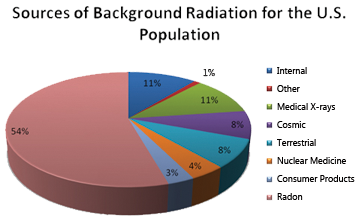
How does radon compare to other forms of radiation?
If you live in a home for 1 year that has exactly 4.0 pCi/L then your radiation exposure is the same as
200 chest x-rays per year. This is based on time exposed so if you are only home half the time, cut the
amount of x-rays in half. If your radon level is twice that amount, then double the number of x-rays.
The Nuclear Regulatory Commission requires all nuclear power plants to put fences around each facility
at a distance far enough away so that a person standing at the fence line will not receive any more
radiation than 25 mRem. They use the same formula for around nuclear waste sites. That’s a lot of
“ticks” on a Geiger counter and a house with 4 pCi/L is worse than that! Just because you can’t see the
radiation doesn’t mean it’s not there. X-ray technicians wear lead aprons and stand as far away as
possible. Take the same approach by either reducing the amount of radon in your home or stay away
from home as much as possible. It’s usually much easier just to have the radon problem fixed.
Testing is the only way to know if you and your family are at risk from radon. EPA and the Surgeon
General recommend testing all homes below the third floor for radon.
You cannot predict radon levels based on state, local, and neighborhood radon measurements. Do not
rely on radon test results taken in other homes in the neighborhood to estimate the radon level in your
home. Homes which are next to each other can have different radon levels. Testing is the only way to
find out what your home's radon level is.
How does radon cause cancer?
All radioactive elements break down (radioactive decay) over time through a process measured in half-
lives. As these elements breakdown, they actually create entirely new elements, each with its own
specific half-life. Each time a new element is created, it releases more radiation. The faster this occurs,
the more the radiation is produced. As radon breaks down, it creates other radioactive elements called
radon progeny or daughters - each with even shorter half-lives that break down again, again and again
in half-lives from minutes to just fractions of a second.
Each time an element breaks down, it explodes with energy, radioactive energy strong enough to form
a small crater on glass when observed through a microscope. If these explosions occur within the
human body, for example while breathing, the radiation can be deposited on a cell, either killing it or
forcing it to repair itself. Fortunately, cells often do an excellent job of repairing themselves but
sometimes, the DNA structure within the cell changes. The mutated cell then begins to multiply and
cancer begins to spread. The more cells that are exposed to radiation, the greater the risk of cell
mutation.
Children's cells are still growing and changing rapidly so they are at the greatest risk as well as anyone
who spends a great deal of time at home. Unfortunately, the human body does not produce symptoms
or warning signs to alert us when being exposed to radiation. Radon causes cancer, but does not
cause headaches, nausea or other feelings of ill health. Most people won't know they have cancer until
they hear it from their doctor. The only way to know if your family is being exposed is to test.
How is radon measured?
Radon is measured in pico-Curies per liter of air (pCi/L), a standard unit used worldwide for radiation to
measure the number of decays (radioactive explosions) that occur within 1 liter of air every 60 seconds.
It was named after Madame Curie.
1 pCi/L equals 2.2 radioactive explosions every minute in every liter of air. That doesn’t sound like much
until you consider the amount of air within a house. For example, a 1,000 square foot home with 4pCi/L
will have about 2 million explosions occurring in that house every single minute of every day.
How does radon compare to other forms of radiation?
If you live in a home for 1 year that has exactly 4.0 pCi/L then your radiation exposure is the same as
200 chest x-rays per year. This is based on time exposed so if you are only home half the time, cut the
amount of x-rays in half. If your radon level is twice that amount, then double the number of x-rays.
The Nuclear Regulatory Commission requires all nuclear power plants to put fences around each facility
at a distance far enough away so that a person standing at the fence line will not receive any more
radiation than 25 mRem. They use the same formula for around nuclear waste sites. That’s a lot of
“ticks” on a Geiger counter and a house with 4 pCi/L is worse than that! Just because you can’t see the
radiation doesn’t mean it’s not there. X-ray technicians wear lead aprons and stand as far away as
possible. Take the same approach by either reducing the amount of radon in your home or stay away
from home as much as possible. It’s usually much easier just to have the radon problem fixed.
How does radon accumulate in my home?
Within everyone's homes are different pressures.
You can't feel them but they are there. The upper
portion of a home is under a positive pressure with
air trying to get out and the lower portion of the
home is under a negative pressure with air trying to
get in. Somewhere in the middle is the neutral
pressure zone where air isn't trying to get out or
in. So the higher you go, the stronger the positive
pressure. The lower you go, the stronger the
negative pressure. It is this negative pressure, that
pulls radon into our homes. The greater the
temperature differential between the inside of our
homes and the temperature outside our homes,
the greater the pressures become.
Within everyone's homes are different pressures.
You can't feel them but they are there. The upper
portion of a home is under a positive pressure with
air trying to get out and the lower portion of the
home is under a negative pressure with air trying to
get in. Somewhere in the middle is the neutral
pressure zone where air isn't trying to get out or
in. So the higher you go, the stronger the positive
pressure. The lower you go, the stronger the
negative pressure. It is this negative pressure, that
pulls radon into our homes. The greater the
temperature differential between the inside of our
homes and the temperature outside our homes,
the greater the pressures become.
How do I reduce the amount of radon in my home?
The most effective way to get rid of radon is to install a removal system that draws the radon out of
the soil before it even has an opportunity to enter the house. These systems are called "Sub Slab
Depressurization Systems" or "Active Soil Depressurization Systems". These systems operate by using
a piping and fan system that depressurizes the soil that surrounds the home. This in effect reverses
the pressure differential between the soil and the lower portion of your home. You'll still have the same
pressures within your house that you've always had and never noticed, but the radon will be vented
safely outside so that it can dissipate harmlessly into the atmosphere. It doesn’t take much of a
pressure differential to draw radon into a home, and it doesn’t take a lot of pressure to draw it out.
Are there other health benefits from a sub-slab depressurization system?
Of course the single largest benefit of having a radon removal system is low radiation exposure and a
greatly reduced chance of getting cancer, but many other benefits have also been reported. As radon
removal systems safely exhaust the radon, they also remove other chemicals and gases that are
commonly found in the soil around our homes like insecticides, pesticides, herbicides, methane and
carbon dioxide. Cleaner air means better health. The systems also remove moisture from the ground
and can help to keep basements drier and prevent mold growth.
Have scientists found any correlation between radon and other diseases besides lung cancer?
“In a study conducted at the University of North Dakota , researchers discovered that the presence of
radioactive radon daughters in the brains of non-smoking persons with Alzheimer’s and Parkinson’s
disease was 10 times greater than it was in the brains of persons with no previous evidence of
neurological disorders.” For more information click on the following link: http://www.radonnews.
org/pages/AlzeheimersParkinsons.html
“The north-west of Ireland appears to have one of the highest prevalence rates of Multiple Sclerosis
in Ireland though there is as yet no reliable national database," said the report. "The area is one of the
highest radon-emitting areas in Ireland , with Donegal, in particular, containing some of the most highly
uranium-enriched granites in the country." Multiple sclerosis is a chronic neurological condition which
has no cure. Its cause is unknown although it is likely to be genetic, as well as triggered by
environmental factors. For more information click on the following link: http://www.mult-sclerosis.
org/news/Jan2003/MSandRadonGas.html
What is the cost of installing and running a radon mitigation system vs. lung cancer treatment
for a year?
The average exterior radon mitigation system supplied by our company is $665. The average cost
to run the system for a year is about the same as keeping a light on, approximately $60. The cost of
lung cancer treatment for a year is approximately $45,000.
The most effective way to get rid of radon is to install a removal system that draws the radon out of
the soil before it even has an opportunity to enter the house. These systems are called "Sub Slab
Depressurization Systems" or "Active Soil Depressurization Systems". These systems operate by using
a piping and fan system that depressurizes the soil that surrounds the home. This in effect reverses
the pressure differential between the soil and the lower portion of your home. You'll still have the same
pressures within your house that you've always had and never noticed, but the radon will be vented
safely outside so that it can dissipate harmlessly into the atmosphere. It doesn’t take much of a
pressure differential to draw radon into a home, and it doesn’t take a lot of pressure to draw it out.
Are there other health benefits from a sub-slab depressurization system?
Of course the single largest benefit of having a radon removal system is low radiation exposure and a
greatly reduced chance of getting cancer, but many other benefits have also been reported. As radon
removal systems safely exhaust the radon, they also remove other chemicals and gases that are
commonly found in the soil around our homes like insecticides, pesticides, herbicides, methane and
carbon dioxide. Cleaner air means better health. The systems also remove moisture from the ground
and can help to keep basements drier and prevent mold growth.
Have scientists found any correlation between radon and other diseases besides lung cancer?
“In a study conducted at the University of North Dakota , researchers discovered that the presence of
radioactive radon daughters in the brains of non-smoking persons with Alzheimer’s and Parkinson’s
disease was 10 times greater than it was in the brains of persons with no previous evidence of
neurological disorders.” For more information click on the following link: http://www.radonnews.
org/pages/AlzeheimersParkinsons.html
“The north-west of Ireland appears to have one of the highest prevalence rates of Multiple Sclerosis
in Ireland though there is as yet no reliable national database," said the report. "The area is one of the
highest radon-emitting areas in Ireland , with Donegal, in particular, containing some of the most highly
uranium-enriched granites in the country." Multiple sclerosis is a chronic neurological condition which
has no cure. Its cause is unknown although it is likely to be genetic, as well as triggered by
environmental factors. For more information click on the following link: http://www.mult-sclerosis.
org/news/Jan2003/MSandRadonGas.html
What is the cost of installing and running a radon mitigation system vs. lung cancer treatment
for a year?
The average exterior radon mitigation system supplied by our company is $665. The average cost
to run the system for a year is about the same as keeping a light on, approximately $60. The cost of
lung cancer treatment for a year is approximately $45,000.


Don’t wait call today!
$725 vs. $45,000